
On this page
- What gutter repair covers
- How a proper repair is done
- Matching problems to repairs
- Repair services
- The parts most often fixed
- When to replace instead
- Why Fairfax gutters need repairs
- Repair pricing
- Questions for a repair contractor
- Repairs by season
- Before you call about a repair
- Common repair mistakes
- Repairs and the attic
- Repair in older and newer neighborhoods
- How long repairs last
What gutter repair covers
Repairs deal with the parts of a system that fail first: joints that leak, fasteners that loosen, downspouts that clog or get crushed, wood behind the gutter that rots, and sections bent by snow, ice, wind or limbs. A good repair finds the cause, fixes it, and checks the rest of the run while the ladder is up.
How a proper repair is done
- Find the real source with a hose; water often runs along the underside before dripping.
- Clean the area to bare metal.
- Fix fasteners and wood: replace spikes with hidden hangers and soft fascia with new boards.
- Rivet and reseal joints with gutter sealant.
- Replace damaged sections in matching size and color.
- Reset slope toward the outlets.
- Clear and test downspouts.
- Run water through to confirm the fix.
Matching problems to repairs
| Problem | Likely cause | Repair |
|---|---|---|
| Drips at corners | Sealant failed at the miter | Clean, rivet, reseal |
| Drips at joints every 10–20 ft | Sectional gutter | Reseal, or replace with seamless |
| Sagging between hangers | Spikes out, hangers too far apart | Hidden hangers, closer spacing |
| Gutter pulling off | Soft fascia | Replace fascia, rehang |
| Bent after winter | Ice and sliding snow | Replace section, add hangers |
| Overflow at one spot | Clog, valley flow, small outlet | Clear, diverter, bigger downspout |
| Wet basement wall | Downspout discharging at the wall | Extension or buried line |
Repair services
| Repair | Page |
|---|---|
| Leaking gutters | Leaking gutters |
| Sagging gutters | Sagging gutters |
| Downspout repair | Downspout repair |
| Fascia and soffit | Fascia and soffit |
| Storm damage | Storm damage |
| Ice dams and snow | Ice dams and snow |
The parts most often fixed
| Part | What it is |
|---|---|
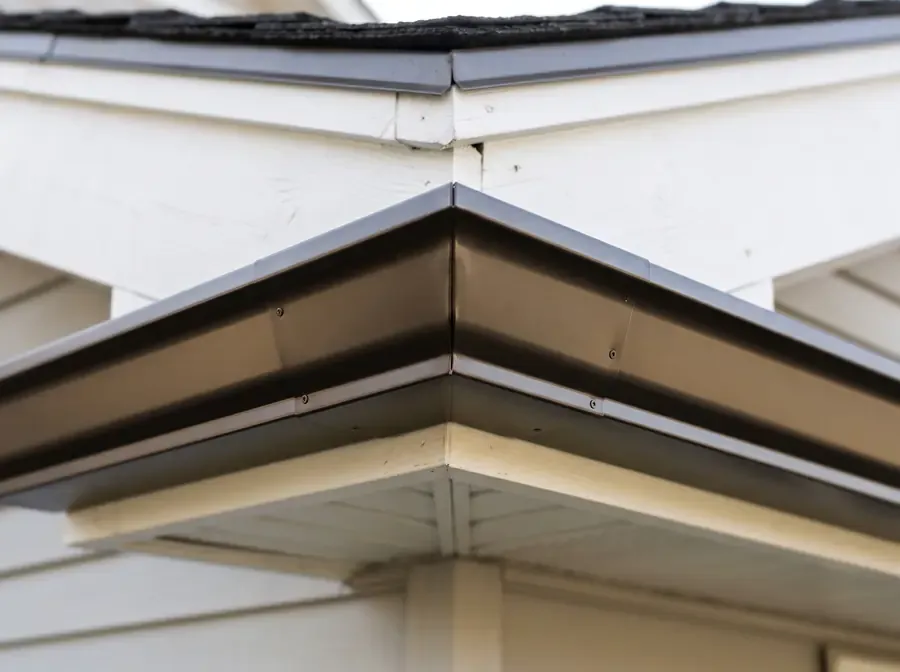
| miter | Corner joint where two runs meet at an angle, made from a formed piece or a cut and riveted joint, then sealed. |
| end cap | Plate closing the end of a run, crimped or riveted on and sealed inside. |
| outlet | Opening cut in the bottom of the trough with a sleeve, called a drop, that feeds the downspout. |
| hidden hanger | Bracket that sits inside the gutter and screws through its back into the fascia, out of sight from the ground. |
| spike and ferrule | Old-style fastening: a long nail driven through a metal tube and the gutter face into the board. Prone to backing out. |
| fascia | Board nailed across the rafter tails along the eave; the gutter's hangers are screwed into it. |
| downspout | Vertical pipe carrying water from the outlet to the ground, commonly 2x3 or 3x4 inches rectangular, or 3 or 4-inch round. |
When to replace instead
Replacement makes more sense when leaks are at most joints, spikes are pulling out along every run, the gutters are too small for the roof, steel is rusting through, or damage is widespread. See repair or replace and gutter replacement.
Why Fairfax gutters need repairs
Freeze and thaw. Winters swing above and below freezing, which cracks old sealant and works fasteners loose. Ice in the trough adds weight.
Snow. Dulles has seen storms of 32.4 inches in February 2010 and 29.3 inches in January 2016. Snow sliding off steep roofs can bend gutters and rip out hangers.
Wind and limbs. Thunderstorm winds and falling branches cause a lot of damage under Fairfax's canopy. Ash trees have been dying since emerald ash borer was reconfirmed in Fairfax County on July 14, 2008.
Age. Suburbs such as Springfield and Annandale grew after World War II, and plenty of houses still carry older gutters on old fascia.
Repair pricing
Small repairs such as resealing a corner or reattaching a downspout are usually modest jobs. Rehanging a run, replacing sections or fascia work cost more. If repairs approach the price of new gutters, compare both. National guides put new 5-inch seamless aluminum at about $9 to $13 a foot installed, per Angi.
Questions for a repair contractor
- What is causing the problem?
- Will you fix the cause or only the symptom?
- Are the gutters worth repairing, or close to replacement?
- Will new parts match?
Repairs by season
| Season | Common repairs |
|---|---|
| Spring | Bent runs and loose hangers after winter; cracked corners |
| Summer | Storm and limb damage; overflow at valleys |
| Fall | Clogs, sags from wet leaves |
| Winter | Ice damage, frozen downspouts (repaired on mild days) |
Before you call about a repair
Note where the problem is, when it happens, the number of stories and any storm date. Photos help.
Common repair mistakes
- Caulking over dirty, old sealant.
- Driving spikes back into the same holes.
- Hanging gutters on soft fascia.
- Fixing the leak but leaving the downspout at the basement wall.
Repairs and the attic
Some gutter damage, such as ice-bent runs and rotted fascia under the eaves, starts with heat escaping into the attic. Fixing attic air leaks and insulation alongside the gutter repair keeps it from coming back.
Repair in older and newer neighborhoods
In postwar areas such as Annandale, Springfield and Mantua, repairs often start with the wood: fascia painted many times hides rot that will not hold a screw. In neighborhoods built from the 1980s on, such as Fair Oaks, Chantilly and Centreville, builder gutters are reaching the age when corners leak and spikes back out. In Old Town Fairfax, repairs to half-round, copper and built-in gutters may need city review.
How long repairs last
A corner cleaned, riveted and resealed properly, or a run rehung on hidden hangers into sound wood, typically lasts many years. Quick fixes over old sealant or into soft wood rarely last a winter.