
On this page
- What does a gutter installation include?
- How a careful installer works
- Sizes and profiles
- Choosing a metal
- What is different about installing gutters around Fairfax?
- Installation services
- Parts of a new system
- What installation costs
- Questions to ask an installer
- New gutters on new construction
- Common installation mistakes
- How long new gutters last
- Before you call about new gutters
What does a gutter installation include?
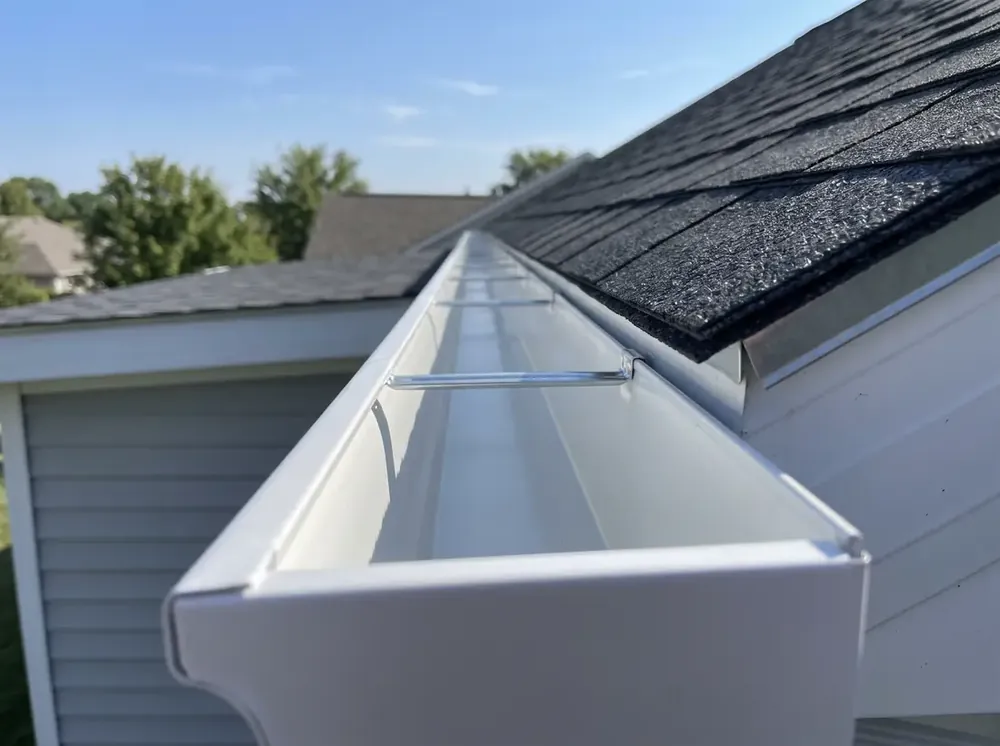
An installation fits a complete drainage system to the roof edge. The gutter collects runoff, hangers hold it at a slight fall, outlets and downspouts bring the water down, and extensions or buried lines carry it away from the walls. Most Fairfax houses get seamless aluminum formed on site from a coil, so each eave is a single piece and the only joints are at corners, ends and outlets.
How a careful installer works
- Remove the old system and look closely at the fascia, soffit and drip edge.
- Fix the roof edge: replace soft wood and add drip edge or apron where it is missing.
- Measure every eave and mark outlet positions.
- Form each run on the machine to length.
- Snap a slope line toward the outlets, about a quarter inch over ten feet.
- Hang on hidden hangers about every two feet, closer at corners and below valleys.
- Rivet and seal miters, end caps and outlets.
- Fit downspouts, strap them top, middle and bottom.
- Set extensions or buried lines to discharge well clear of the foundation.
- Test with water and walk the job with you.
Sizes and profiles
| 5-inch K-style | 6-inch K-style | Half-round | |
|---|---|---|---|
| Typical downspout | 2x3 | 3x4 | 3 or 4-inch round |
| Capacity | Standard | Much greater | Lower than K-style at the same width |
| Suits | Ramblers, small roofs | Large or steep roofs, valleys | Older and traditional houses |
| National price per foot | about $9–$13 | about $12–$18 | Usually higher than K-style |
National ranges from Angi and This Old House. See 5-inch vs 6-inch.
Choosing a metal
| Metal | Strengths | Watch for |
|---|---|---|
| .027 aluminum | Light, rust-free, many colors | Dents from ladders and limbs |
| .032 aluminum | Stiffer, handles snow load better | Costs a little more |
| Galvalume steel | Strongest | Rust at cuts and scratches |
| Copper | Longest life, period look | Highest cost |
See aluminum vs steel vs copper.
What is different about installing gutters around Fairfax?
Snow and ice. Dulles averages about 21 inches of snow a season, and big storms have dropped far more. Snow sliding off a roof and ice forming in the trough put real weight on hangers, so close spacing into solid wood matters more here than in milder places.
Thunderstorms. Summer storms bring short, heavy bursts of rain and sudden wind. The June 2012 derecho is the best-known example.
Trees. Fairfax County's canopy covers about 57 percent of the county. Older neighborhoods under mature beech, maple, oak and tulip poplar fill gutters quickly.
Basements. Many houses here have basements or walkouts. Fairfax County advises extending each downspout at least 5 feet from the foundation.
Historic districts. In Old Town Fairfax, changes visible from the street need a certificate of appropriateness.
Installation services
| Service | Page |
|---|---|
| Seamless gutters | Seamless gutters |
| 6-inch gutters | 6-inch gutters |
| Half-round | Half-round gutters |
| Copper | Copper gutters |
| Aluminum | Aluminum gutters |
| Downspouts | Downspouts |
Parts of a new system
| Part | What it does |
|---|---|
| drip edge | Bent metal strip under the first course of shingles that throws runoff out past the fascia and into the trough. |
| hidden hanger | Bracket that sits inside the gutter and screws through its back into the fascia, out of sight from the ground. |
| miter | Corner joint where two runs meet at an angle, made from a formed piece or a cut and riveted joint, then sealed. |
| end cap | Plate closing the end of a run, crimped or riveted on and sealed inside. |
| outlet | Opening cut in the bottom of the trough with a sleeve, called a drop, that feeds the downspout. |
| downspout | Vertical pipe carrying water from the outlet to the ground, commonly 2x3 or 3x4 inches rectangular, or 3 or 4-inch round. |
| extension | Section of pipe at the base of the downspout that carries water several feet out from the foundation. |
| slope | The fall a run is hung at toward its outlet, typically about a quarter inch over ten feet. |
What installation costs
National guides from Angi and This Old House put seamless aluminum at about $9 to $13 a foot installed for 5-inch and $12 to $18 for 6-inch, steel at about $6 to $14, and copper at about $25 to $40. Height, corners, fascia repair, downspout count and removal of old gutters all change the total. See the Fairfax cost guide.
Questions to ask an installer
- Will the gutters be seamless and formed at the house?
- What size and gauge, and why for this roof?
- How far apart will the hangers be, and what will they screw into?
- How many downspouts, and where will each discharge?
- Is old gutter removal included?
- How will you handle soft fascia?
New gutters on new construction
On a new build or addition, gutters go up after roof and trim and before final grading. Ask about 6-inch gutters, 3x4 downspouts and buried lines planned with the landscaping, since adding them later costs more.
Common installation mistakes
- Too few outlets on long or steep runs.
- Corners held by sealant alone.
- Hangers into soft fascia.
- Runs hung level, holding water that freezes.
- Downspouts discharging at the foundation.
How long new gutters last
Seamless aluminum on sound fascia, hung on hidden hangers and kept clean, commonly lasts for decades. Copper lasts longer still. The joints and fasteners need the most attention over time.
Before you call about new gutters
- Approximate eave length and number of stories.
- Any problems with the current gutters.
- Trees near the roof.
- Basement or walkout, and where water now goes.
- Any HOA or historic district rules.