
On this page
- What gutter cleaning involves
- When to clean in Fairfax
- Steps in a proper cleaning
- Checklist items
- Cleaning by area
- What skipping cleaning costs
- Pricing
- Related services
- Cleaning terms
- A cleaning visit, step by step
- What a cleaning quote should include
- Signs cleaning is overdue
- Before you book
- Cleaning and winter
- A Fairfax example
- What skipping cleaning costs
- Do it yourself safely
- Cleaning around Old Town
- Why Fairfax gutters fill so fast
- Cleaning and basements
What gutter cleaning involves
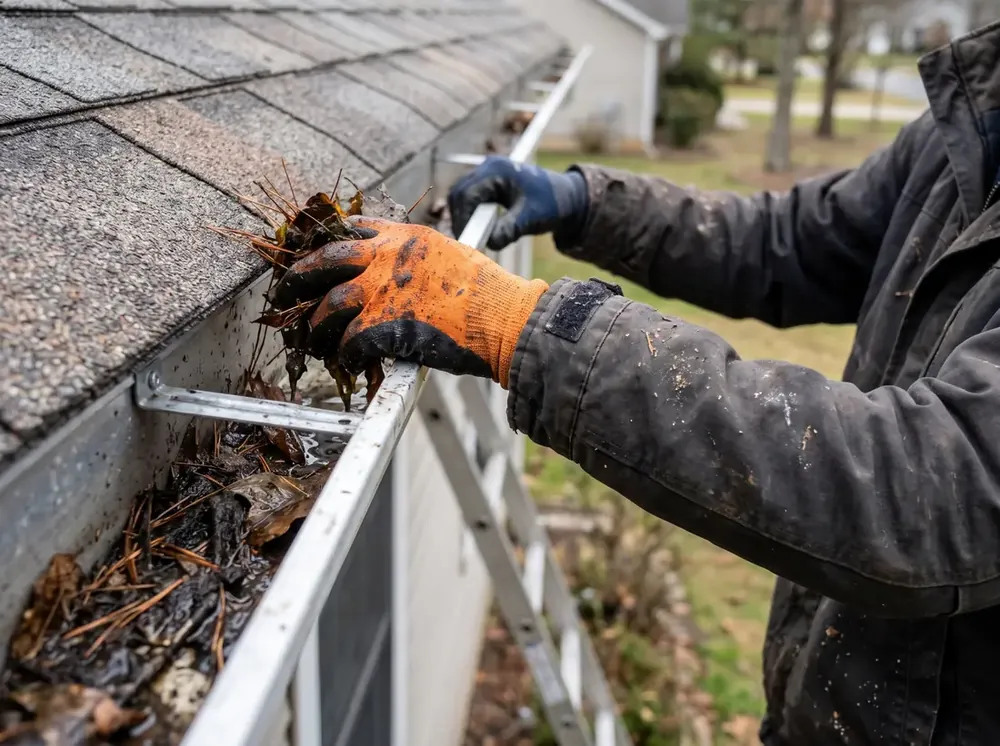
A proper cleaning clears the troughs by hand, flushes every downspout, checks buried lines, and looks over hangers, corners and fascia. Debris is bagged and removed, not left in the beds against the house.
When to clean in Fairfax
| Season | What fills gutters | Why it matters |
|---|---|---|
| April–May | Red maple seeds, tulip poplar flowers, oak catkins | Clear before summer storms |
| June–August | Twigs and leaves after storms | Overflow in downpours |
| October–December | Beech, maple, oak and tulip poplar leaves | Biggest load of the year |
| January–March | Twigs, needles, roof grit | Water held in the trough freezes |
Steps in a proper cleaning
- Set ladders safely with stabilizers that keep weight off the gutter.
- Remove debris by hand into bags.
- Flush troughs toward each outlet.
- Clear downspouts from top and bottom, opening elbows if needed.
- Test buried lines with water.
- Check hangers, corners, slope and fascia.
- Note problems with photos.
Checklist items
| Item | What to look for |
|---|---|
| Troughs | Standing water, seedlings, grit |
| Outlets | Partial blockages |
| Downspouts | Packed elbows, crushed sections |
| Buried lines | Backing up at the downspout |
| Hangers | Loose or missing |
| Fascia | Soft spots, peeling paint |
| Extensions | Missing, too short, moved by mowers |
Cleaning by area
| Area | Typical cleanings a year |
|---|---|
| Old Town Fairfax, Vienna, McLean, Annandale | 3–4, mature street and yard trees |
| Burke, Oakton, Mantua, Springfield | 2–3 |
| Fairfax Station, Clifton | 3–4, wooded lots |
| Centreville, Chantilly, Fair Oaks | 1–2 in newer sections |
| Reston, Herndon | 2–3, near wooded paths and lakes |
What skipping cleaning costs
Clogged gutters overflow onto siding and window wells, rot fascia, hold weight that pulls hangers, and help ice build in winter. Downspouts packed with leaves back water into the trough. Those repairs usually cost more than the cleaning.
Pricing
Cleaning is priced per visit, by house height, footage, the amount of debris and whether downspouts and buried lines are flushed. Two-story houses and steep roofs cost more than ramblers. Many contractors offer regular visits.
Related services
- Gutter guards to cut down cleaning.
- Downspout repair for clogs and crushed pipes.
- How often to clean gutters.
Cleaning terms
| Term | Meaning |
|---|---|
| outlet | Opening cut in the bottom of the trough with a sleeve, called a drop, that feeds the downspout. |
| downspout | Vertical pipe carrying water from the outlet to the ground, commonly 2x3 or 3x4 inches rectangular, or 3 or 4-inch round. |
| A and B elbows | Pre-bent downspout fittings; A elbows turn toward or away from the wall and B elbows turn sideways. |
| buried drain line | Pipe run underground from the downspout to an outlet in the yard, away from the house. |
| cleanout | Removable fitting on a buried line so it can be flushed or snaked without digging. |
A cleaning visit, step by step
- Walk-around to spot overflow marks, loose runs and missing downspouts.
- Ladders set on firm ground with stabilizers.
- Debris removed by hand and bagged.
- Troughs flushed toward each outlet.
- Downspouts cleared top and bottom.
- Buried lines tested.
- Photos and notes of problems.
What a cleaning quote should include
- Number of stories and footage.
- Whether downspouts and buried lines are flushed.
- Debris bagged and removed.
- How small repairs are priced.
- Guard cleaning if guards are fitted.
Signs cleaning is overdue
- Water spills over in moderate rain.
- Seedlings grow in the trough.
- Gutters sag.
- Downspouts trickle.
- Wasps or birds nest at the gutter.
Before you book
Note stories, guards, buried downspouts, trees overhead and any leaks seen, so the contractor can check them.
Cleaning and winter
A clean in late fall, after the last leaves and before hard freezes, keeps water from sitting and freezing in the trough over winter.
A Fairfax example
A two-story house in Vienna under mature oaks and a tulip poplar overflowed every summer storm despite a November cleaning. Moving to three visits, late May, early December and a check after the first big summer storm, kept the downspouts clear. Adding micro-mesh on the back eaves later cut that to one visit a year.
What skipping cleaning costs
Clogged gutters overflow onto siding and window wells, soak fascia, add weight that pulls hangers, and give ice a head start in winter. Those repairs nearly always cost more than cleaning.
Do it yourself safely
On a one-story house, cleaning is a reasonable DIY job: a stable ladder with a stabilizer, gloves, a scoop and a bucket, and a hose to flush toward the outlet. Never lean the ladder on the gutter, keep away from the power line to the house, and skip the job on wet, windy or icy days. Two-story houses are safer left to a contractor with the right equipment.
Cleaning around Old Town
Older houses with half-round gutters and tall eaves under street trees fill quickly. Cleaning gives a chance to check brackets and cornice wood, which are often the first parts to fail.
Why Fairfax gutters fill so fast
Fairfax County lists American beech, red maple and tulip poplar as its most common trees, and each fills gutters at a different time. Red maples drop winged seeds in spring that sprout in a damp trough within weeks. Tulip poplars shed flower parts in late spring and seed cones into fall. Beech, oak and maple leaves come down from late October into December. A house under all three can need a cleaning in every season.
Cleaning and basements
When gutters overflow, water lands right against the foundation. On houses with basements, keeping gutters clear and downspouts discharging at least 5 feet out is one of the cheapest ways to keep walls dry.