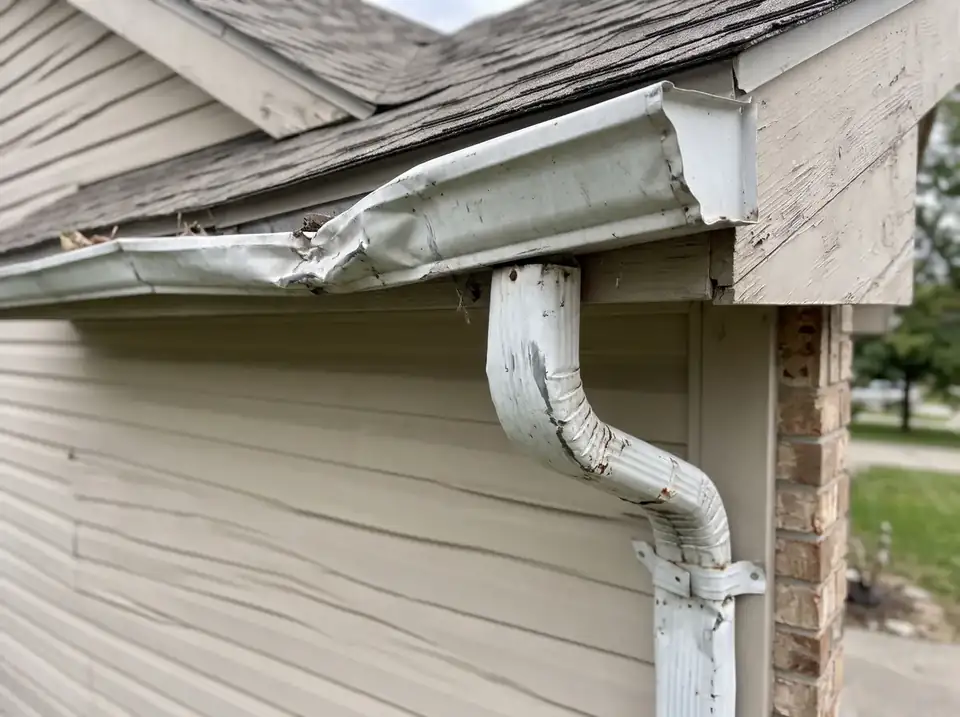
Thunderstorm winds pry gutters off at the ends, limbs crush them, and hail dents them. Document the damage first, then decide on repair or replacement.
Stay safe and keep clear of hanging gutters and wires.
Photograph everything from the ground.
Keep fallen pieces.
Note the date and time.
Call your insurer if the roof or siding may be damaged.
Book an inspection.
Repairs by type of damage
Damage
Usual repair
Run torn off but straight
Rehang with closer hangers
Run bent or creased
Replace section
Crushed by a limb
Replace section; check fascia
Hail dents that still drain
Often left or noted for a claim
Split corners
Reseal or new miter
Downspouts crushed
Replace
Fascia torn
Replace and rehang
Parts often damaged
Part
Meaning
K-style gutter
The usual modern profile: flat back and bottom with a decorative front, sold in 5 and 6-inch sizes.
miter
Corner joint where two runs meet at an angle, made from a formed piece or a cut and riveted joint, then sealed.
hidden hanger
Bracket that sits inside the gutter and screws through its back into the fascia, out of sight from the ground.
downspout
Vertical pipe carrying water from the outlet to the ground, commonly 2x3 or 3x4 inches rectangular, or 3 or 4-inch round.
fascia
Board nailed across the rafter tails along the eave; the gutter's hangers are screwed into it.
.032 aluminum
Heavier coil that resists dents from limbs, ladders and hail, and sags less under load.
Choosing a contractor after a storm
Virginia's Board for Contractors requires a license for projects worth more than $1,000; a Class C license covers projects up to $30,000. Ask for the license number and check it on the DPOR website. Get a written quote and read any document that assigns insurance payments before signing.
Insurance notes
Policies differ; ask what counts as covered wind, hail or falling-object damage.
Dated photos help an adjuster.
Gutter damage is often part of a roof claim.
Ask for an itemized estimate listing gutters, downspouts and fascia.
Read any assignment of benefits before signing.
Checks after each kind of storm
After
Look for
Hail
Dents, crushed downspouts, cracked corners
High wind or downburst
Lifted ends, pulled-off runs
A fallen limb
Bent runs, torn fascia, roof damage
Heavy snow
Bent runs, pulled hangers
Making gutters tougher
When storm-damaged gutters are replaced, consider closer hanger spacing at corners, well-strapped downspouts, heavier .032 aluminum or steel, and trimming limbs over the roof.
Before anyone climbs a ladder after a storm, look up for hanging limbs and down for wires. Gutter repairs can wait a day; injuries cannot.
Making gutters tougher after a storm
When storm-damaged gutters are replaced, ask about closer hanger spacing at corners and ends, well-strapped downspouts, heavier .032 aluminum or steel, and having a tree professional trim limbs over the roof.
Before you call about storm damage
Storm date and time.
Photos of each damaged section.
Whether the roof or siding was hit too.
Whether an insurance claim is open.
Whether any limbs are still on the roof.
Common questions
What should I do right after a storm?
Photograph gutters, downspouts, roof edge and siding from the ground, keep fallen pieces and keep people away.
Will insurance cover it?
Wind, hail and limb damage is often part of a roof or exterior claim; it depends on your policy.
Can a torn-off run be reused?
If it came off straight, sometimes. Bent runs are replaced.
What about a limb on the gutter?
Have it removed safely first, by a tree professional if it is large or near wires.
How soon can repairs happen?
After big storms contractors book in order. Get on the list early.
Should I hire whoever knocks on my door?
Take your time, check the Virginia license and get a written quote.
Should I push dents out?
They rarely come out cleanly; leave them for inspection.
How long do I have to claim?
Check your policy soon after.
Can I use a temporary fix?
Lowering a hanging run safely from a ladder is fine; leave permanent work to a contractor.
Do I need a Virginia license to fix my own gutters?
No; licensing applies to contractors. If you hire someone for work over $1,000, the firm needs a DPOR license.