
On this page
- What downspouts do
- Sizes and types
- Where the water should go
- Basements and the ground
- Parts
- How downspouts are installed
- How many downspouts?
- Mistakes to avoid
- Rain gardens
- Downspouts on typical Fairfax houses
- Downspouts in winter
- Downspouts at a glance
- Where this comes up around Fairfax
- A practical tip
- Before you call about downspouts
What downspouts do
Downspouts carry water from the gutter outlet to the ground and, with an extension or buried line, away from the house. A gutter that works perfectly still causes trouble if its downspout empties next to the basement wall.
Sizes and types
| Type | Opening | Use |
|---|---|---|
| 2x3 rectangular | About 6 sq in | 5-inch gutters, smaller roofs |
| 3x4 rectangular | About 12 sq in | 6-inch gutters, busy roofs |
| 3-inch round | Smaller | Half-round on smaller roofs |
| 4-inch round | Larger | Half-round on larger roofs |
Where the water should go
Fairfax County's flood guidance says each downspout should have an extension reaching at least 5 feet from the foundation, and that water should not be directed onto neighboring properties. The county also describes disconnecting rooftop runoff so it spreads over lawn or planted areas instead of running straight to the street.
Basements and the ground
Many Fairfax houses have full basements or walkouts. Water released at the wall soaks the soil against them and finds cracks. Extensions, buried lines and soil that slopes away keep it out.
Parts
| Part | Meaning |
|---|---|
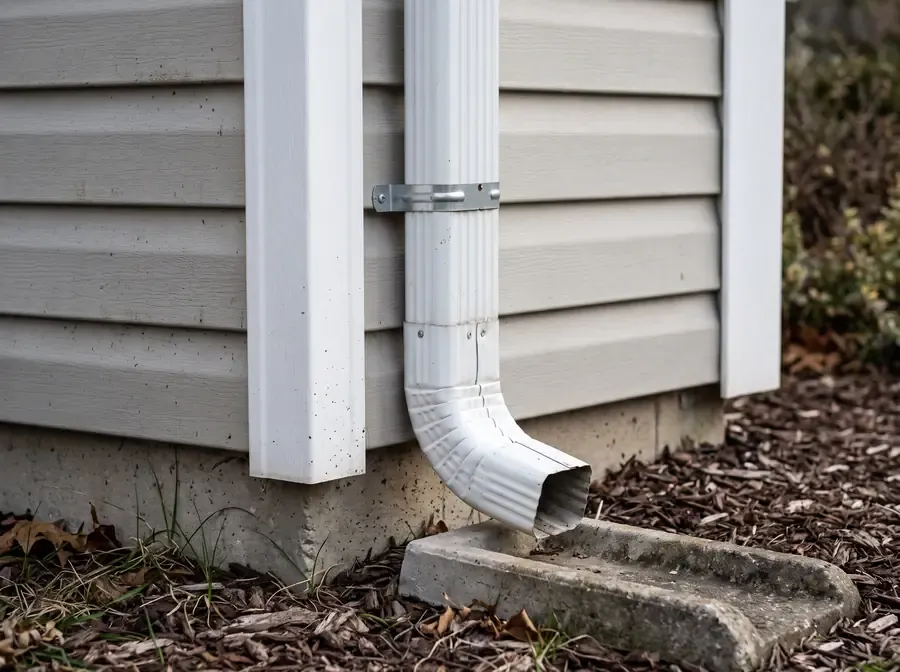
| downspout | Vertical pipe carrying water from the outlet to the ground, commonly 2x3 or 3x4 inches rectangular, or 3 or 4-inch round. |
| A and B elbows | Pre-bent downspout fittings; A elbows turn toward or away from the wall and B elbows turn sideways. |
| downspout strap | Bracket fastening the downspout to the wall so wind and ladders cannot work it loose. |
| extension | Section of pipe at the base of the downspout that carries water several feet out from the foundation. |
| splash block | Concrete or plastic tray under a downspout that spreads water as it lands. |
| buried drain line | Pipe run underground from the downspout to an outlet in the yard, away from the house. |
| pop-up emitter | Cap at the far end of a buried line that lifts open when water arrives and closes when it stops. |
| cleanout | Removable fitting on a buried line so it can be flushed or snaked without digging. |
How downspouts are installed
- Cut the outlet and fit the drop.
- Fit elbows to bring the pipe to the wall.
- Strap top, middle and bottom.
- Fit the bottom elbow and extension.
- Dig and lay buried lines where needed, with a cleanout.
- Test with water.
How many downspouts?
| Run | Usual outlets |
|---|---|
| Short run under 30 ft | One |
| Long run 30–60 ft | Two, or a center outlet |
| Run below a valley | Extra outlet near the valley |
| Lower roof below a second story | Extra capacity |
Mistakes to avoid
- Water released beside basement walls or window wells.
- Crushable corrugated pipe for buried lines.
- No cleanout on buried lines.
- Extensions that mowers keep knocking off.
- Sending water toward a neighbor.
Rain gardens
The Northern Virginia Soil and Water Conservation District runs rain garden workshops and guides, and its Conservation Assistance Program offers technical help and funding for projects such as rain gardens and dry wells in Fairfax County and the City of Fairfax. A downspout aimed at a rain garden turns roof water into a garden feature.
Downspouts on typical Fairfax houses
| House | Typical downspouts |
|---|---|
| Rambler | Two to four drops, 2x3 or 3x4 |
| Two-story colonial | Five to eight 3x4 drops |
| Older house in Old Town | Round, sometimes with collector heads |
| Townhome | One or two per unit, often shared |
Downspouts in winter
Water trickling through a partly blocked downspout can freeze solid in a cold snap, backing water into the gutter where it adds to ice at the eave. Keeping outlets and elbows clear before winter, and discharging onto lawn rather than walks and driveways where it can ice over, avoids both problems.
Downspouts at a glance
| Question | Short answer |
|---|---|
| Sizes | 2x3, 3x4, 3 or 4-inch round |
| Minimum discharge | 5 feet, per Fairfax County |
| Neighbors | Do not aim water at them |
| Buried lines | Smooth pipe with a cleanout |
| Winter | Keep elbows clear before freezes |
| Help | NVSWCD rain garden programs |
Where this comes up around Fairfax
| Area | What to know |
|---|---|
| Mantua | Creek-side lots with basements |
| Fairfax Station | Sloping lots and walkouts |
| Centreville | Townhome walks that ice over |
| Annandale | Older downspouts at basement walls |
A practical tip
Look at where each downspout discharges after a storm. Bare soil, a gully or a puddle by the wall tells you which one to fix first.
Before you call about downspouts
- Where each downspout discharges.
- Whether the basement or crawl space gets damp.
- Whether any downspouts connect to buried lines.
- Where water could safely go on the lot.
- Any walks or drives that ice over in winter.