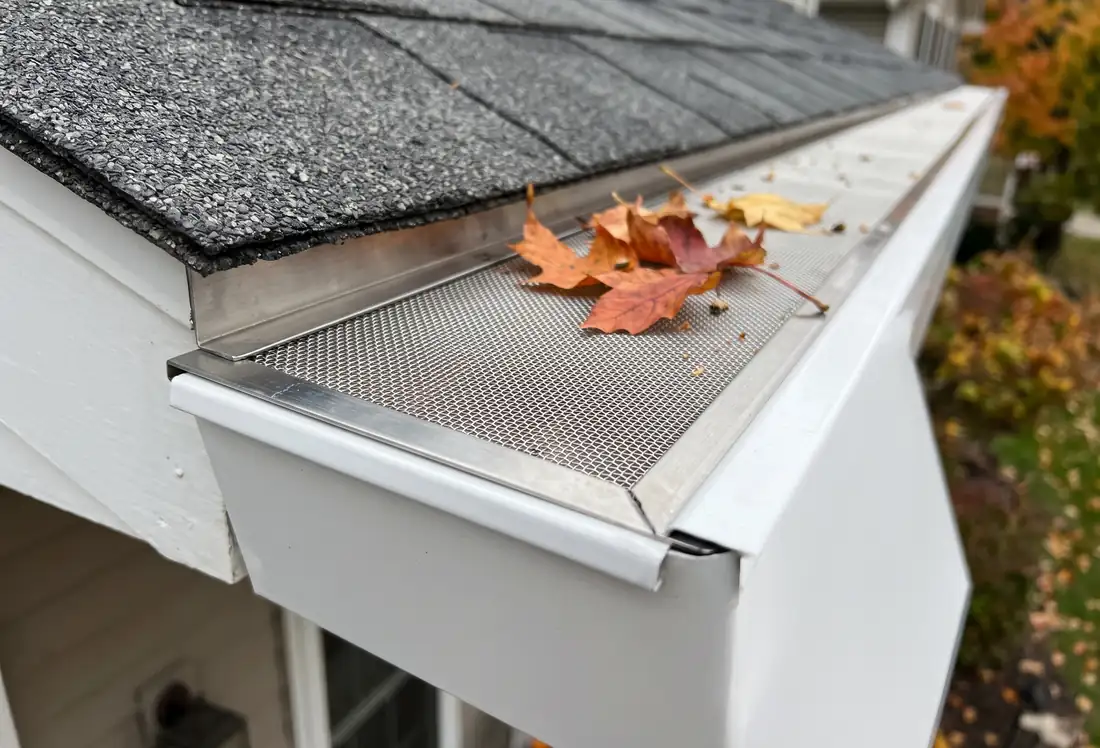
Screen guards are perforated or expanded metal laid over the trough. Reverse-curve guards are solid hoods; water clings to the rounded front and drops into a slot while leaves slide off.
How they compare
Screen
Reverse-curve
Micro-mesh
Large leaves
Stops
Sheds
Stops
Seeds and flower parts
Many get in
Some enter slot
Stops
Pine needles
Poke through
Mostly shed
Stops
Heavy rain, steep roof
Good
Can overshoot
Good
Ice
Can ice over
Slot can freeze
Can hold snow on top
Cost
Lowest
Middle to high
Middle to high
Where they make sense
Screens: one-story houses under big-leaf trees.
Hoods: moderate-pitch roofs with mostly large leaves.
Micro-mesh: where seeds, flower parts and needles are the problem. See micro-mesh guards.
Trees and guard choice
Tree
Screen
Reverse-curve
Micro-mesh
Oak
Good
Good
Best
Beech
Good
Good
Best
Red maple
Seeds through
Seeds in slot
Best
Tulip poplar
Flower parts through
Some in slot
Best
Pine
Needles through
Mostly shed
Best
Fitting
Repair and clean gutters.
Fit screens to the lip and under the drip edge or to the fascia.
Fit hoods to match the roof pitch.
Finish corners.
Test.
Guard terms
Term
Meaning
screen guard
Perforated or expanded metal panel with larger openings; stops big leaves but lets small debris through.
reverse-curve guard
Solid hood with a rounded nose; water follows the curve into a slot while leaves slide off the front.
gutter insert
Foam or brush filler set inside the trough; cheap, but it traps fine debris and breaks down.
micro-mesh guard
Stainless mesh fine enough to stop seeds, needles and grit, held in a frame over the trough.
drip edge
Bent metal strip under the first course of shingles that throws runoff out past the fascia and into the trough.
Cost and lifespan
Type
Relative cost
Typical life
Plastic snap-in screen
Lowest
Short
Aluminum or steel screen
Low to middle
Medium
Reverse-curve hood
Middle to high
Long
Stainless micro-mesh
Middle to high
Long
DIY screens
Snap-in metal screens can work on a one-story house under big-leaf trees. Match the gutter size and make sure the back edge sits flat without lifting shingles. Leave hoods and two-story work to a contractor.
When to switch
If screens let maple seeds and tulip poplar parts through every spring, or hoods overshoot in storms or ice over in winter, switch the worst eaves to micro-mesh.
Before buying any guard, stand under the gutter in a spring rain and look at what washes out of the downspout. Big leaves only means a screen may do; seeds, petals and needles mean mesh.
A Fairfax example
An Annandale rambler sits under two big pin oaks. The owner snaps metal screens onto the 5-inch gutters, and in fall the oak leaves stay on top and blow off. In spring, oak catkins and pollen slip through and form a mat beneath the screens, so the owner lifts a few panels each May and flushes the trough. On a steeper two-story roof in Vienna with a red maple overhead, the same screens would let maple seeds through all spring; micro-mesh suits that house better.
Before you call about screens or hoods
Tree species overhead.
Roof pitch: low, moderate or steep.
Whether seeds or needles are part of the problem.
Gutter size.
Whether you want to install screens yourself on a low roof.
Common questions
What is a screen guard?
A perforated or expanded metal cover with openings larger than micro-mesh.
What is a reverse-curve guard?
A solid hood; water follows the curved nose into a slot.
Do hoods overflow?
On steep roofs in heavy rain, water can shoot past the curve.
How do hoods handle ice?
The slot and curve can ice over in cold snaps.
Can I install screens myself?
Snap-in screens on a one-story house are a common DIY job.
How long do they last?
Metal screens last longer than plastic.
Do screens fit 6-inch gutters?
If sized for them.
Can hoods be removed for cleaning?
Some lift off; ask.
Do screens work with half-round?
Some are made for it; fewer choices.
What does hail do to screens?
Thin ones dent and plastic cracks.
Are hoods good on steep roofs?
Water can jump the curve in heavy rain.
Do screens stop acorns?
Yes, they sit on top.
Which is better under oaks, a screen or a hood?
Both shed big oak leaves. Screens cost less and lift off for checking; hoods last longer but can let water overshoot on steep roofs and their slot collects catkins. Under oaks with maples nearby, micro-mesh beats both.
Can I put screens on now and upgrade later?
Yes. Screens are easy to remove, so starting with screens on the worst eaves and moving to mesh later is a reasonable way to spread the cost.
Are plastic screens worth buying?
They are cheap but warp and crack in sun and cold; metal lasts far longer.